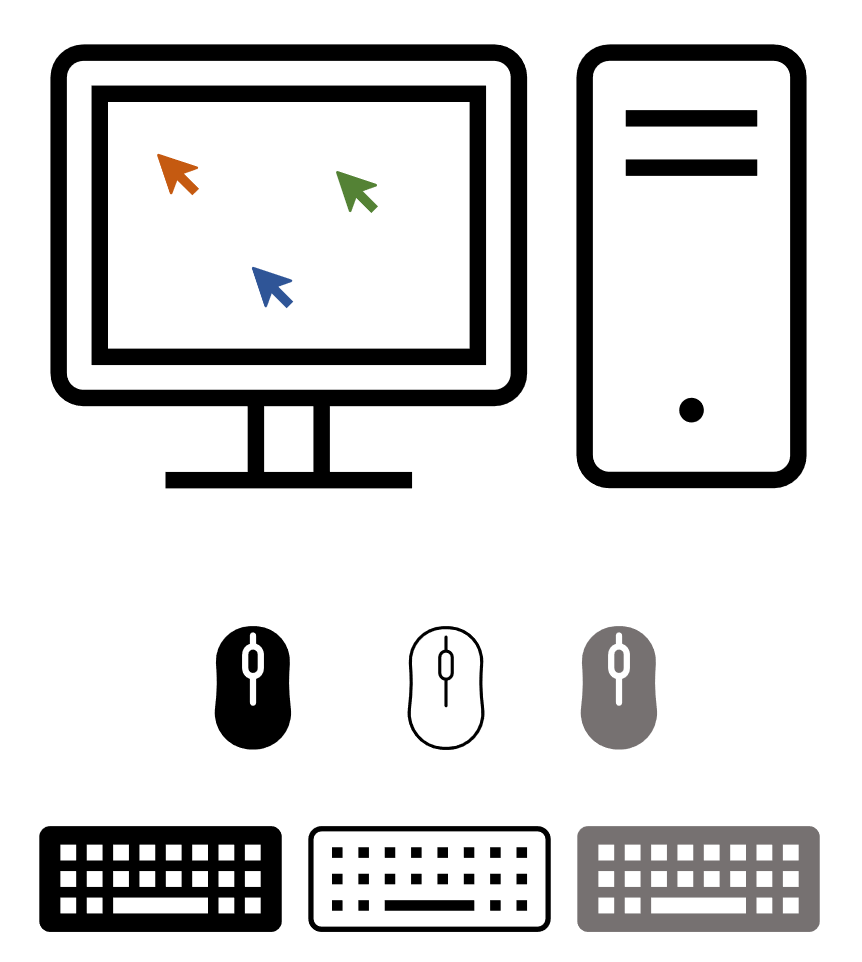
Each user gets their own cursor and can simultaneously work on the same Windows desktop. Configure each individual pointer device (acceleration, cursor theme, wheel and button behaviour etc) independently. Collaboration was never so easy!
Download (Or read some more on what features we have)
=
Multi-user Remote Desktop
Major updates to MouseMux! We now support RustDesk for multi-user remote desktop collaboration. This BETA includes new collaborative apps (Multi Paint, Team Vote, Whiteboard), smarter keyboard remapping, performance optimizations with cursor caching and high-DPI mouse support, a new Web SDK, and many bug fixes. As this is a beta release, you may encounter small inconsistencies. Your feedback is highly appreciated!
Our goal is to make working together as intuitive and simple as possible. Just add some extra pointer devices (mice, pens, touchpads) and (optional) keyboards and MouseMux will transform your PC into a realtime multi-user system. Each user can work in their own document, annotate on the screen, drag or resize windows or interact with different programs - all at the same time on the same windows desktop. Simple annotations allow each user to highlight parts of the screen. Concurrently interacting with different apps on the same desktop creates new and interesting ways to work together; collaborate by taking over certain actions, type together, draw together - all at the same time without interfering others.
Use it for pair programming, collaborative designing, in the class or meeting room (so all can interact and have a presence on the screen). Join forces on editing documents, or in the control room so each operator can see where the others are.
Use it to customize your mouse (or pen, touch or tablet) interaction; custom acceleration, assigned buttons, themes or wheel behavior - for each individual pointer device. Let any pointer device act as any other (mouse, pen, touch, etc). Record macro's and play them back to automate tasks, even in a multi cursor scenario. Having a cursor for each mouse means you can quickly interact with individual applications because cursors can be localized or dedicated to one program - the restriction of moving one cursor all over the screen and refocusing on a specific application is lifted. The screen's realastate becomes much more manageable.
In Industrial processes including manufacturing, process control, power generation, fabrication, and refining, and facility processes, including buildings, airports, ships, and space stations where multiple operators work in SCADA like situations safe multiuser operation is vital. MouseMux can manage individual users and can store historical data of any interaction. Assigning a supervisor and overriding actions by other operators is now possible - SCADA programs can integrate with our SDK so true simultaneous interaction becomes possible.
"Please obtain a clean ROM" shifts the responsibility outward. "Please" tempers the command with civility; "obtain" implies effort, access, and potentially negotiation with legal or ethical constraints. The qualifier "clean" is loaded: it insists on purity, unmarred by patches, mods, or embedded identifiers. It suggests both technical correctness (no corruption, correct checksums) and moral-legal acceptability (no embedded cheats, no illicit modifications). The phrase therefore sits at an intersection: a technical requirement, a normative demand, and a tacit warning about provenance.
Finally, there is a rhetorical rhythm to the sentence: concise, imperative, and slightly distant. It encapsulates a moment when a machine’s continuity is interrupted and human agency is required to restore it. The imperative to "obtain" focuses on acquisition, not creation—recognizing that some things cannot be legitimately or easily reconstructed from first principles. The request for "cleanliness" asserts values—integrity, authenticity, and respect for both technical correctness and legal-ethical boundaries.
Ethically, the phrase nudges toward responsibility. "Please obtain a clean ROM" can be read as urging caution: verify sources, prefer official dumps or authorized distribution channels, and ensure integrity via checksums and signatures. It presumes an obligation to the platform’s creators and to the broader community of users and archivists who rely on shared norms of provenance. The Dsi Binaries Are Missing Please Obtain A Clean Rom
The phrase is terse, almost clinical: a diagnostic alert, an admonition, a map of absence couched in technical shorthand. At first read it is purely functional—identify a missing dependency, instruct the user to procure a “clean ROM”—but it also hints at deeper tensions between legality, preservation, and the fragility of software ecosystems.
In sum, the brief command is a node where technical reality, moral considerations, and archival impulses converge. It asks not only for a file, but for a responsible act: to restore wholeness without compromising provenance, to bridge absence with care, and to acknowledge that some absences point to larger questions about ownership, preservation, and the lifecycle of digital artifacts. "Please obtain a clean ROM" shifts the responsibility
There is also a pragmatic subtext: missing binaries often result from mundane issues—misplaced files, corrupted storage, incompatible tools—or from deliberate omissions meant to prevent misuse. The solution space spans from the banal (re-download from an official source, restore from backup) to the fraught (acquire dumped images, seek community archives, or reverse-engineer). Each choice carries trade-offs: legality, fidelity to the original, and the risk of malware or compromised builds.
Technically, the instruction implies specific actions: confirm which binaries are missing, identify compatible ROM versions for the target DSi environment, validate integrity (hashes, digital signatures), and ensure the ROM is "clean" (no injected code, no tracking tokens). It hints at the need for tooling—dumpers, checksum utilities, emulators or device-flashing tools—and for careful documentation of versions and sources to avoid accidental drift. It encapsulates a moment when a machine’s continuity
What is missing is literal and symbolic. "DSi binaries" names compiled, platform-specific artifacts: the distilled work of programmers and vendors, the encoded behaviors that make a device do what it was designed to do. Binaries are nontrivial to recreate; they are the resistors and gears of a machine’s personality. Their absence creates a silence in a system that expected to speak. A message that they are "missing" registers a failure of continuity: an archive incomplete, a configuration broken, a chain of custody interrupted.

"Please obtain a clean ROM" shifts the responsibility outward. "Please" tempers the command with civility; "obtain" implies effort, access, and potentially negotiation with legal or ethical constraints. The qualifier "clean" is loaded: it insists on purity, unmarred by patches, mods, or embedded identifiers. It suggests both technical correctness (no corruption, correct checksums) and moral-legal acceptability (no embedded cheats, no illicit modifications). The phrase therefore sits at an intersection: a technical requirement, a normative demand, and a tacit warning about provenance.
Finally, there is a rhetorical rhythm to the sentence: concise, imperative, and slightly distant. It encapsulates a moment when a machine’s continuity is interrupted and human agency is required to restore it. The imperative to "obtain" focuses on acquisition, not creation—recognizing that some things cannot be legitimately or easily reconstructed from first principles. The request for "cleanliness" asserts values—integrity, authenticity, and respect for both technical correctness and legal-ethical boundaries.
Ethically, the phrase nudges toward responsibility. "Please obtain a clean ROM" can be read as urging caution: verify sources, prefer official dumps or authorized distribution channels, and ensure integrity via checksums and signatures. It presumes an obligation to the platform’s creators and to the broader community of users and archivists who rely on shared norms of provenance.
The phrase is terse, almost clinical: a diagnostic alert, an admonition, a map of absence couched in technical shorthand. At first read it is purely functional—identify a missing dependency, instruct the user to procure a “clean ROM”—but it also hints at deeper tensions between legality, preservation, and the fragility of software ecosystems.
In sum, the brief command is a node where technical reality, moral considerations, and archival impulses converge. It asks not only for a file, but for a responsible act: to restore wholeness without compromising provenance, to bridge absence with care, and to acknowledge that some absences point to larger questions about ownership, preservation, and the lifecycle of digital artifacts.
There is also a pragmatic subtext: missing binaries often result from mundane issues—misplaced files, corrupted storage, incompatible tools—or from deliberate omissions meant to prevent misuse. The solution space spans from the banal (re-download from an official source, restore from backup) to the fraught (acquire dumped images, seek community archives, or reverse-engineer). Each choice carries trade-offs: legality, fidelity to the original, and the risk of malware or compromised builds.
Technically, the instruction implies specific actions: confirm which binaries are missing, identify compatible ROM versions for the target DSi environment, validate integrity (hashes, digital signatures), and ensure the ROM is "clean" (no injected code, no tracking tokens). It hints at the need for tooling—dumpers, checksum utilities, emulators or device-flashing tools—and for careful documentation of versions and sources to avoid accidental drift.
What is missing is literal and symbolic. "DSi binaries" names compiled, platform-specific artifacts: the distilled work of programmers and vendors, the encoded behaviors that make a device do what it was designed to do. Binaries are nontrivial to recreate; they are the resistors and gears of a machine’s personality. Their absence creates a silence in a system that expected to speak. A message that they are "missing" registers a failure of continuity: an archive incomplete, a configuration broken, a chain of custody interrupted.
Proudly serving our clients! Let us know if you need a customized/branded version for specific corporate or industrial use.
We're looking for a passionate MouseMux enthusiast to help spread the word! If you love creating content (videos, tutorials, demos), engaging with communities, or just can't stop talking about multi-cursor collaboration, we want to hear from you.
We love people who think outside the box and can spot new opportunities where MouseMux could flourish - whether that's creative use cases, new markets, or ways to reach people who haven't discovered multi-cursor collaboration yet.